ARTICLES
Articles
Long-form articles from Anthus on decision models, agent systems, classifiers in production, and the economics of AI-built software.
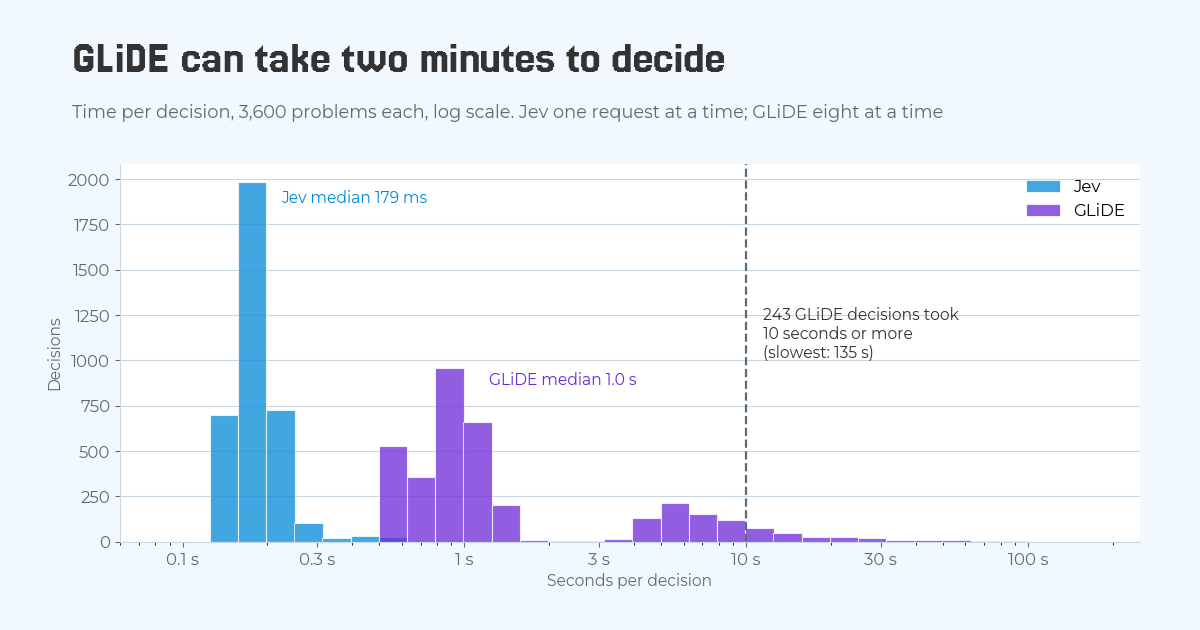
It's Not a System 1 Model If It Takes Ten Seconds
Fastino's GLiDE beats every open model on our reasoning benchmark, but not Jev: less accurate, five times slower, ten times the cost, and a confidence that barely tells right from wrong.
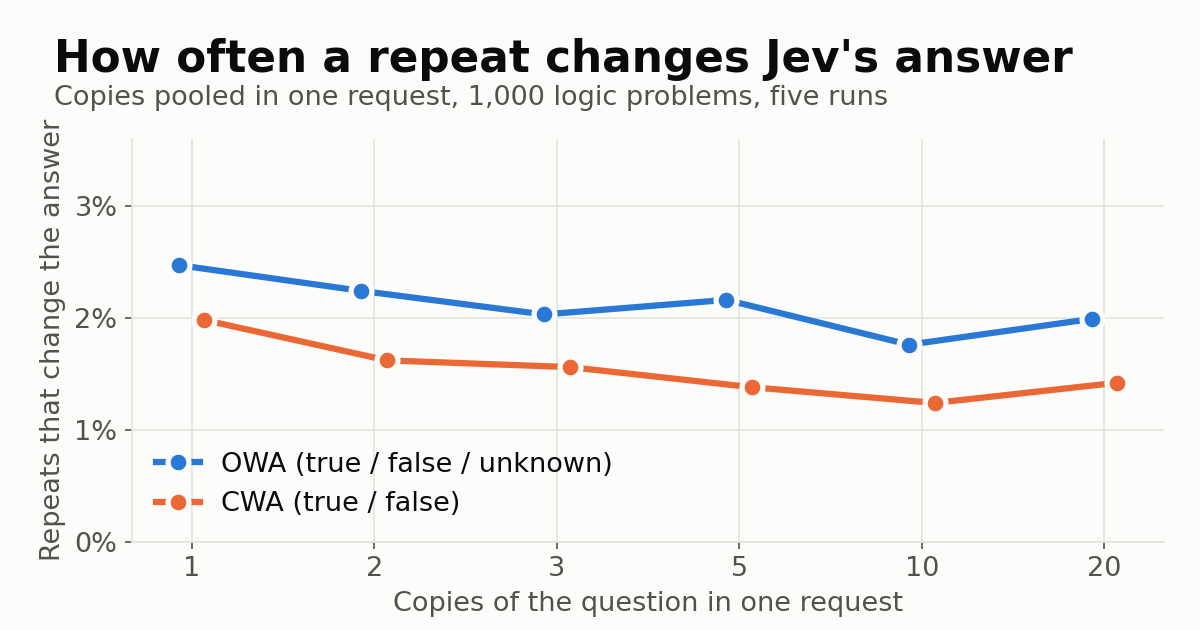
Can Averaging Reduce Noise in an AI Decision Model?
We asked Jev the same question ten times in one request and expected ten identical answers. They split, four votes to six. Kahneman, Sibony and Sunstein call that kind of variation noise. Averaging the copies didn't make Jev more accurate, but it cut changed answers on a rerun by about a third.
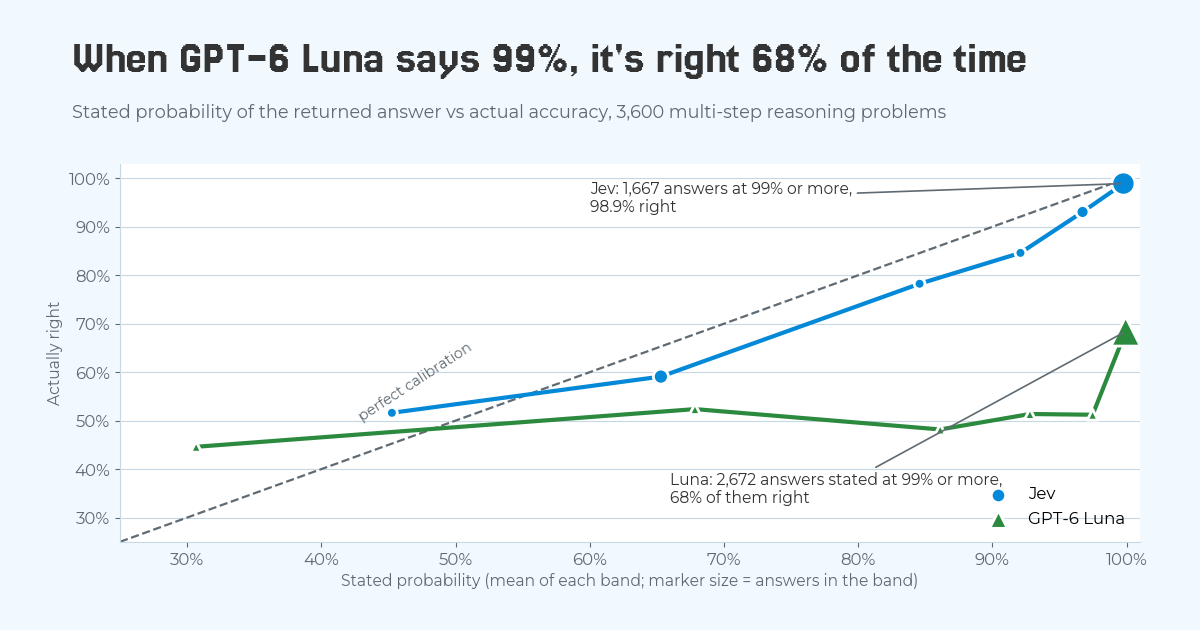
The OpenAI Decisions API Needs a Confidence You Can Trust
We've routed decisions on LLM confidence since 2023, and calibration is what we most hope OpenAI's new Decisions API gets right. The model underneath, GPT-6 Luna, isn't there yet: on 3,600 reasoning problems its 99% meant 68%, and by five inference steps it was at a coin flip.
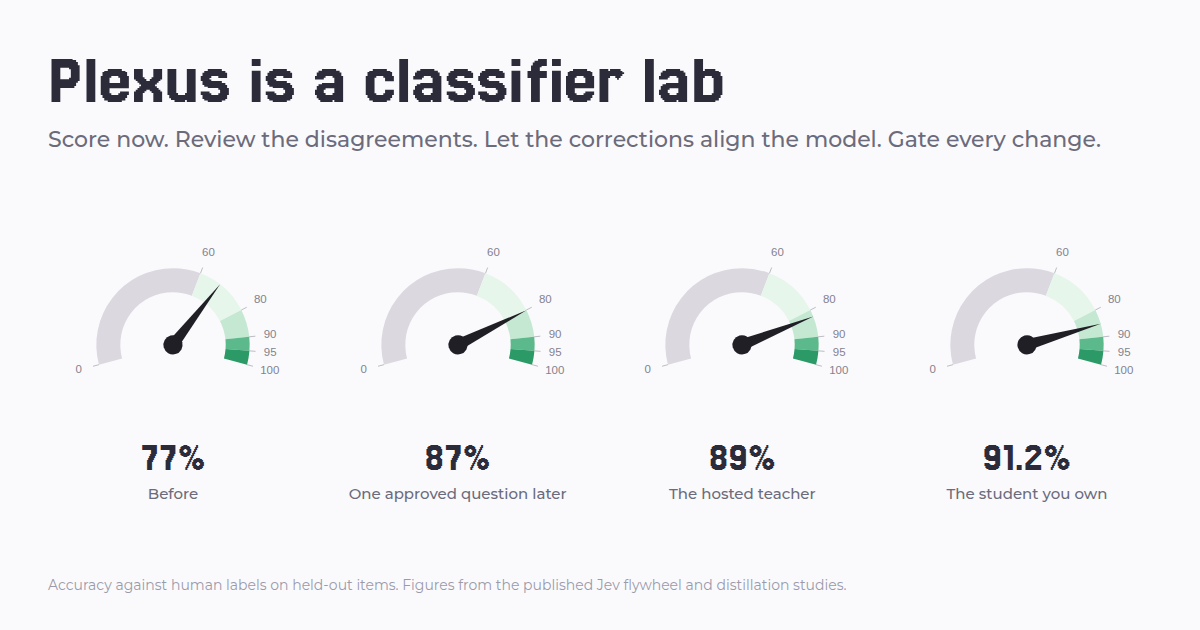
Primus Is a Classifier Lab: Operationalizing Classifiers at Scale
A hosted decision model sat at 77 percent accuracy through 87 rounds of reviewer feedback, then one approved question took it to 87. Here is the loop that did it, every figure published, and the offer to run it on your judgment task.
Decision Models Are Not Calculators
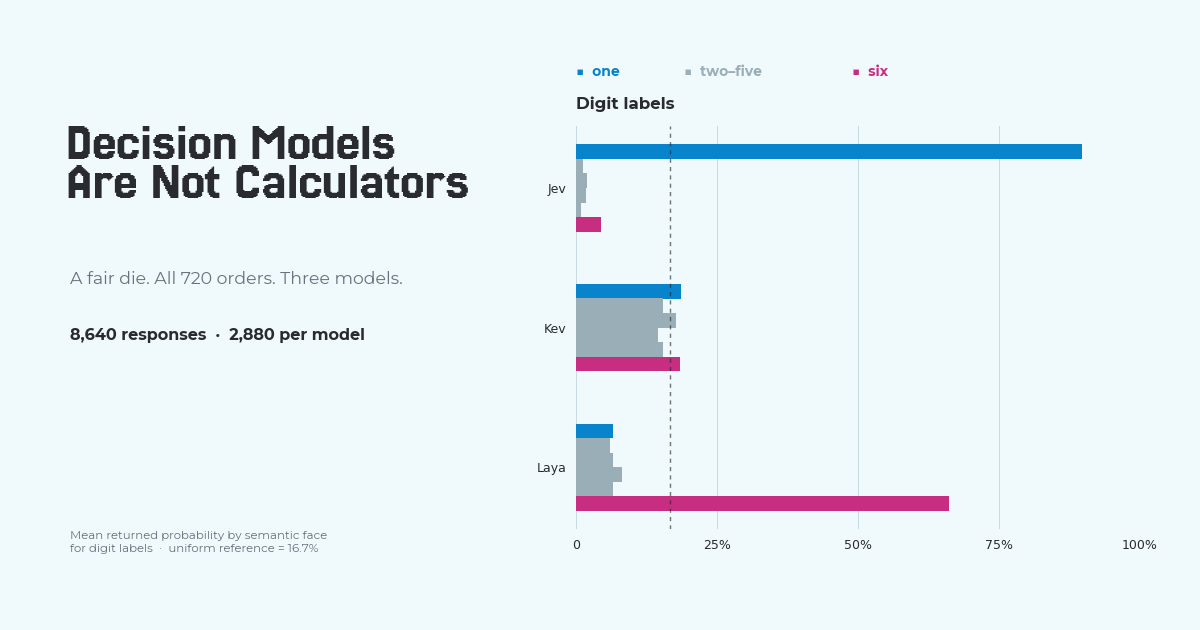
Jev chose one in every ordering of a fair-die question; Kev leaned toward one, and Laya overwhelmingly chose six. Benford's Law remains a hypothesis.
Can You Fix It? Gating, Averaging and Fine-Tuning Against a Gendered Verdict
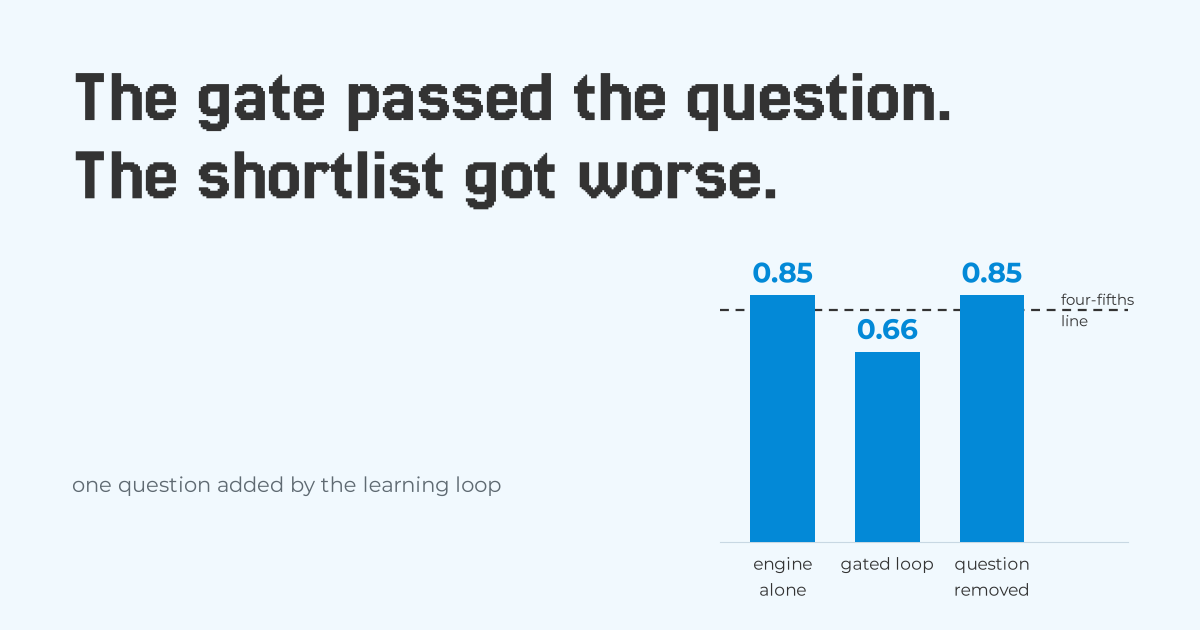
A decision model's verdict moves on "she". We put a gate on the learning loop that rejects any question whose answer moves with the pronoun. It kept out the obvious ones and still made a hiring shortlist worse, because a question can ignore the pronoun and read gender from the words. Here's what worked instead.
We Told the AI She Was a Woman. It Demoted Her
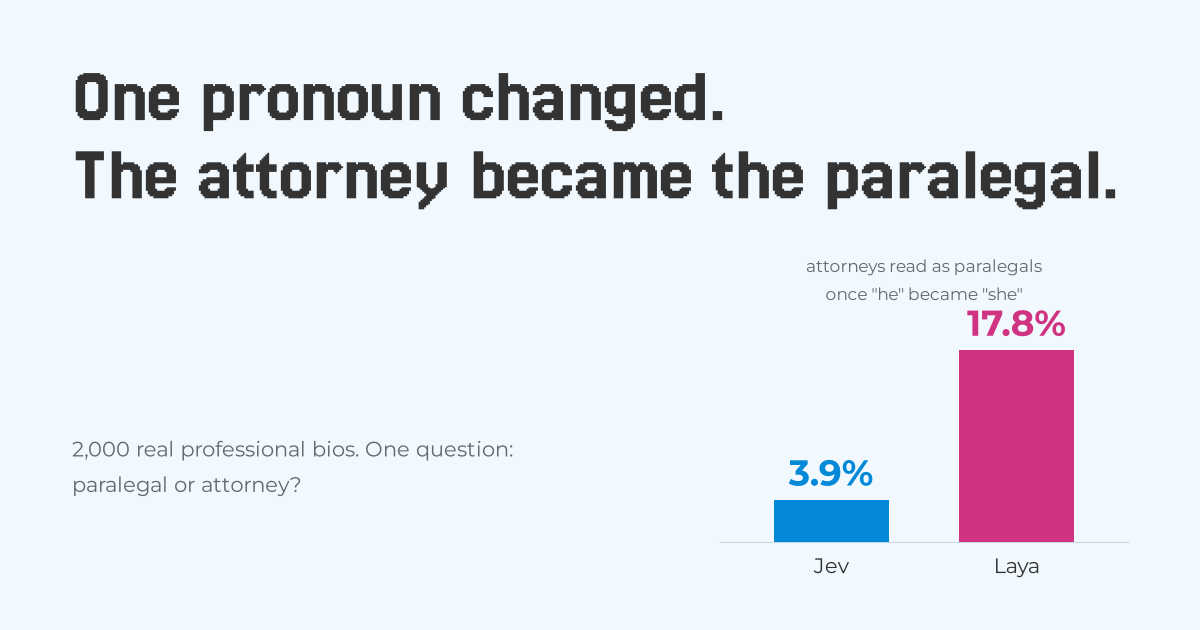
A new kind of AI, the decision model, makes instant decisions about people: who gets an interview, whose claim gets flagged. It's cheap and fast, and companies are adopting it without checking what it does. We checked. It quietly ranks women lawyers below men, and every company using it makes the same mistake.
The One-Word Test: How Jev and Laya Read Gender, Race and Age
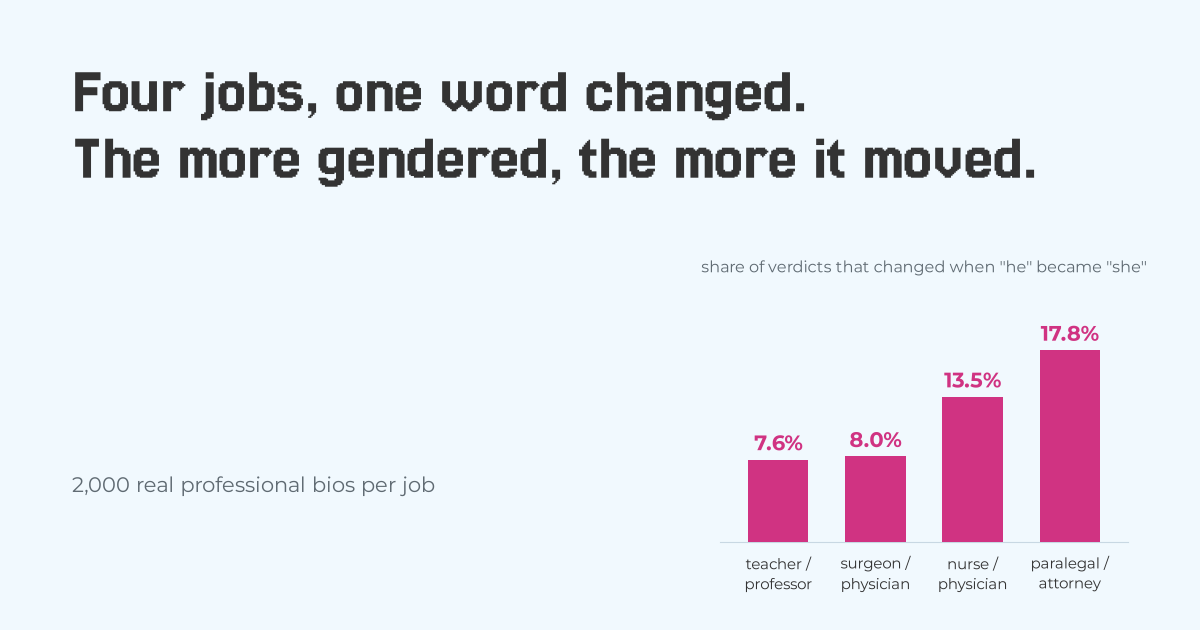
Two thousand real bios per job, first names blanked, one pronoun swapped, both decision models asked twice. Laya's verdict moved on 8 to 18 bios in 100, Jev's on 1 to 4, almost always toward the stereotype. Here is the method, the jobs, the shortlist, and what names and ages do.
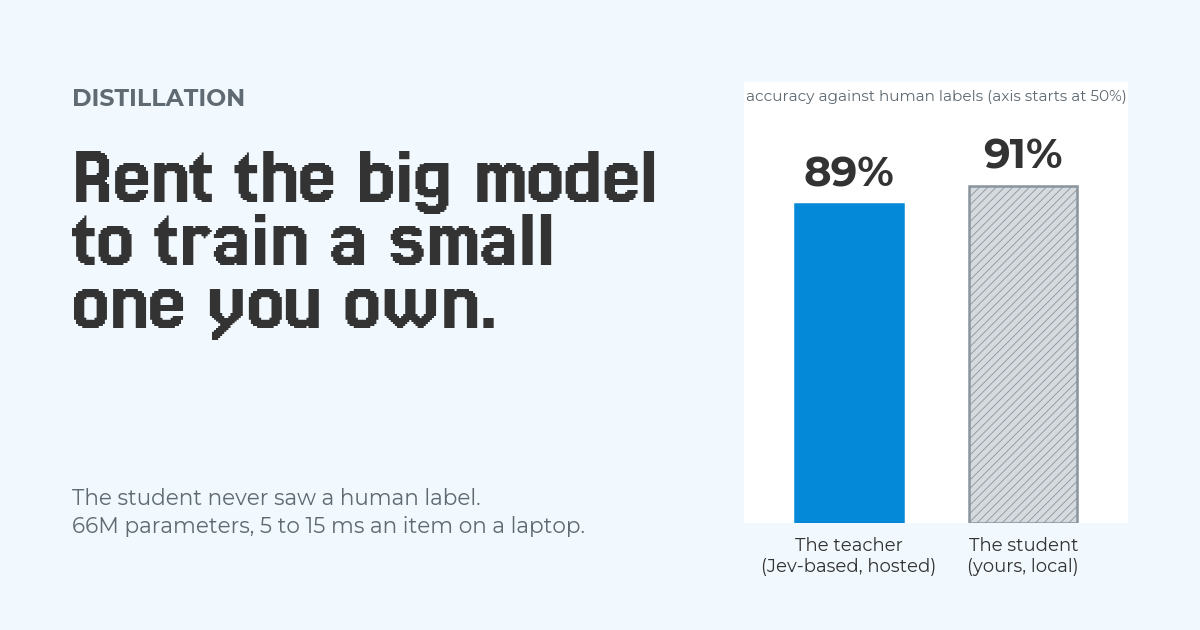
Distilling an Aligned Jev System into a Classifier You Own
A Jev decision model aligned with 140 human labels taught a 66M-parameter DistilBERT that scored 0.912 against the human label, two points above its teacher, at 5.6 to 15 ms an item. The accuracy is the least general part; the per-slice ship gate is the part to copy.
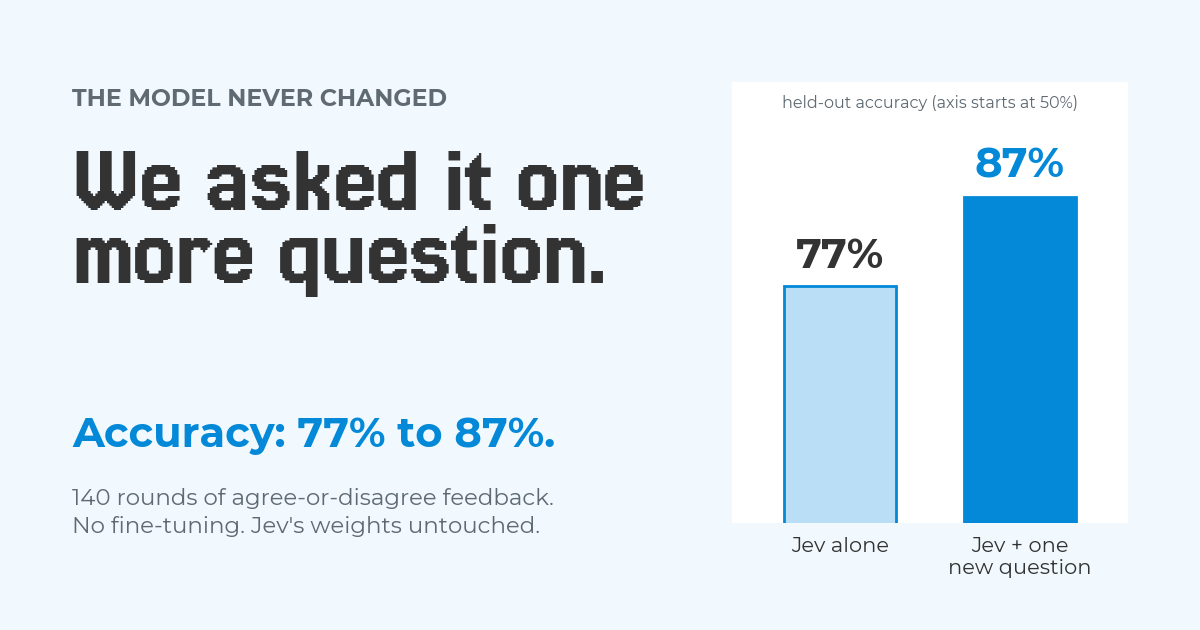
Fine-Tuning Jev: You Can't. Here's What Gets You the Same Effect
You can't fine-tune Jev, or any hosted decision model: TypeSafe serves the same weights to everyone. So we kept it frozen and adapted the questions and a small fitted head around it. On 140 labels, one new plain-English question bought 10 points of accuracy, and it finds the hidden pattern about a quarter of the time.
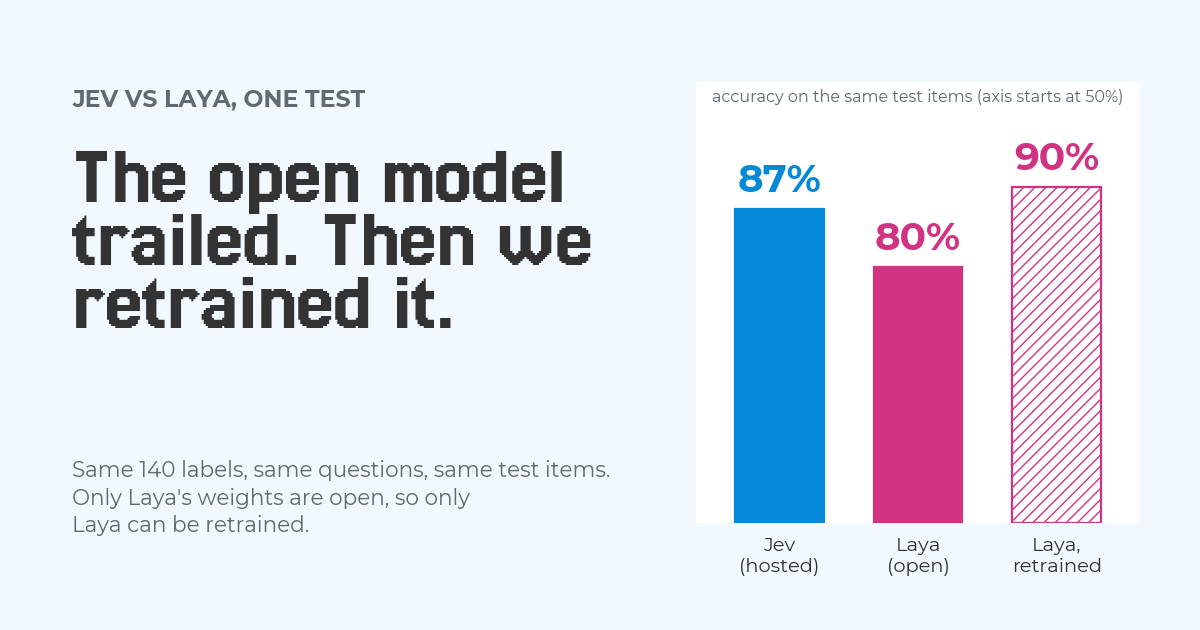
Jev vs Laya: Same Labels, Same Questions, One Variable
We ran two decision models, Jev and the open-weights Laya, through one harness where only the engine changes. Jev led by 4.7 points alone and 6.8 with our feedback layer, and then fine-tuning Laya on the same 140 labels beat both.
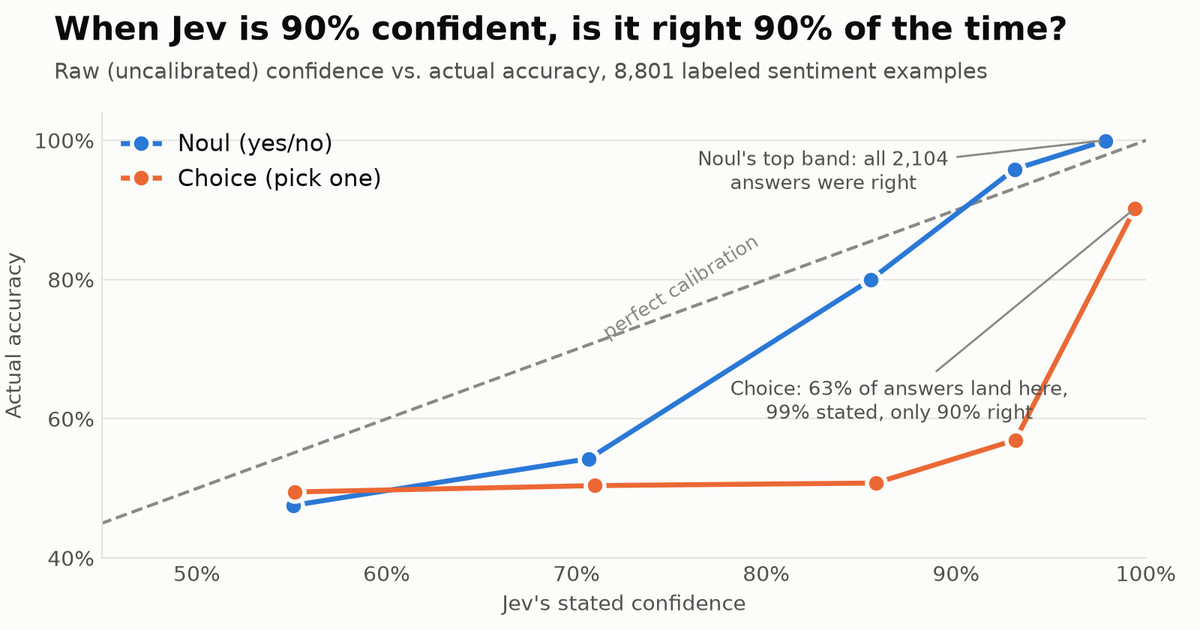
Can You Trust Jev's Confidence?
A decision model's confidence should mean something. Jev's does: higher really does mean more likely right. But on 8,801 labeled examples they ran overconfident, and how you phrase the request changes the pattern. Calibration fixes most of it.
NOT PUBLISHED
Drafts
Served but hidden from search engines and from the normal lists.
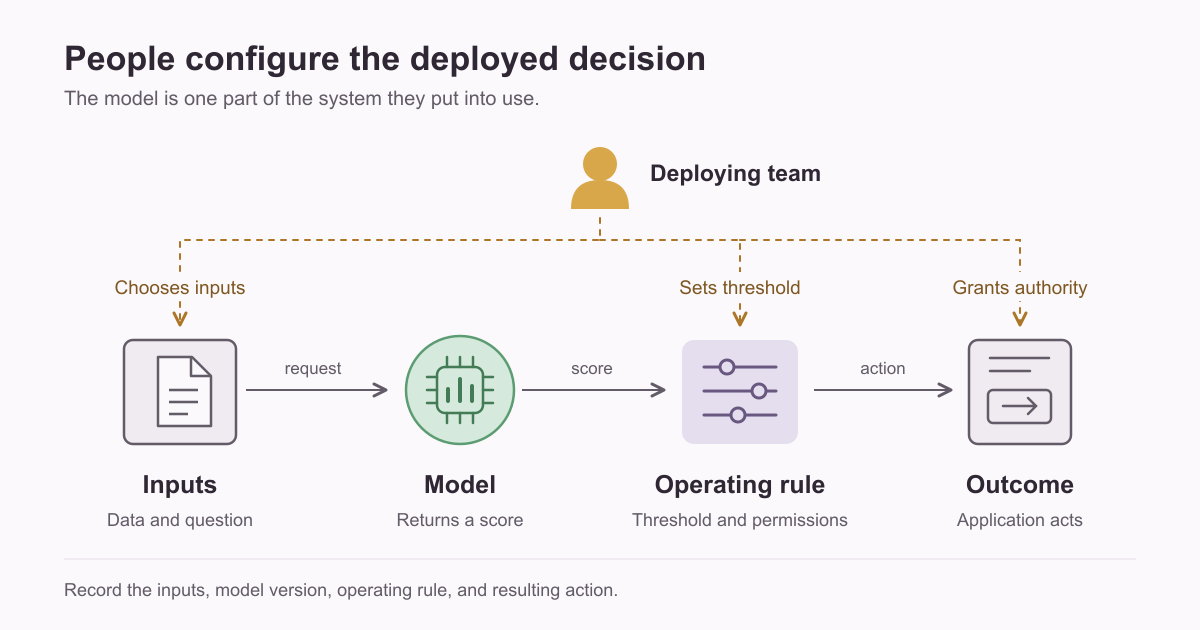
Who Is Responsible After You Deploy a Decision Model?
An AI model can't answer a customer, a reporter, or a regulator. The people who chose its inputs, threshold, and authority can. Here's what that means when an outside bias finding turns into an operating problem.
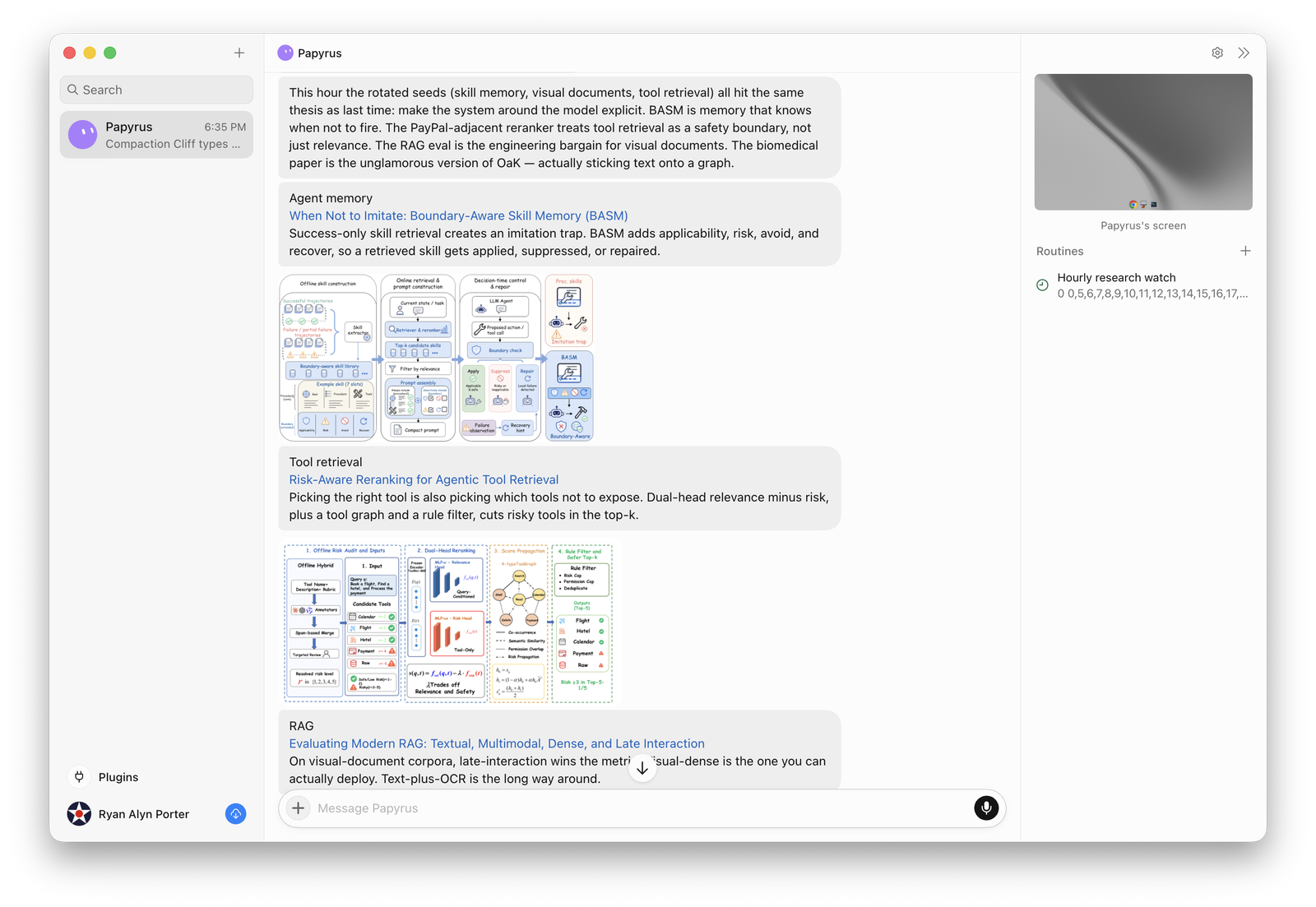
A Week with Grok Bot
A week after my first write-up, Grok Bot's organizational paradigm had clicked hard enough that I started cloning it as Chatticus. I want more of that product shape — not more of the Grok model behind it.
Thrifty tokenmaxxing
They offer you Fast like a free first hit that isn't free. Resist the premium default, watch the leftover clocks, and spend included quota on context hygiene — not on-demand.
Code-Based Hill-Climbing
An agent edits a program, runs a metric, keeps the better version, and repeats. DeepMind uses it to recover 0.7% of Google's compute; Karpathy uses it to train models overnight on one GPU. The loop is the easy part. Everything hard about the technique lives in the thing that decides which version won.
Kanbus: Project Management as Code
When the issue tracker lives in the repository, a ticket becomes a file that diffs, branches, gets reviewed in a pull request, and reverts with the code that closed it. That is a real change in what a ticket is, and it carries real costs: merge conflicts on the board, no permissions model, and nothing that pages you.
Ralph Loops and Loop Engineering
The industry shipped three different verbs and called them all Ralph. A bash while-loop with fresh context, a /goal that keeps one session alive, and a /loop on a timer are cousins, not synonyms. Here is what each one actually does, which products shipped which, and why the failure stories are the most useful part.

A Wiki That Only Gets Bigger
An agent research desk that can add pages but never retire them is not a knowledge base. The missing capability is the boring one: the ability to stamp a page dead, keep the trail, and let a dumb non-AI checker enforce it.

The Year the Coding Agents Went Remote
In 2025, AI engineers were notorious for carrying laptops everywhere with the lids cracked open because closing the lid killed the agent loop. In 2026, three trends converged — cheaper tokens, more autonomous agents, and real remote orchestration — and the laptop-on-the-hip era ended.

The End of the 'Black Box' Score
A 30B model just beat a 671B model using rubrics. We're moving from "vibes" to gatekeepers, shifting AI alignment from intuition to instruction.

Everything as Code: Source a Runtime Can Reject
The useful question when integrating AI with a real system is not whether a model can read it. It is whether anything can say no to what the model writes, before it touches production.

Text Classifier Cookbook
A curated collection of text classification techniques.

Optimizing Efficiency Through Teaching Via Data
We recently demonstrated how a smaller model can solve a problem just as well as a large language model for orders of magnitude lower cost. But how can you create a small, cheap model that does a job as well as an LLM? We demonstrate the use of data, rather than distillation, as a method of teaching a smaller model.

How AI Agents Know Things
If a customer service AI agent at a store reports to you about the status of your order then does that mean that the model has learned personal details about you and your order? How does that work? The simple answer reveals a lot about how AI tools work.
Few-Shot "Learning" Isn't Real
It doesn't help prompt engineers to imagine that language models are learning things from the prompt. Understanding what's really happening can help you write better prompts.

AI Agents: The Future of Automated Intelligence
Software components that can make decisions on their own will shape the future of business efficiency and innovation.